Automotive paint is no longer just about choosing a color. For automotive manufacturers, refinish paint suppliers, and coating formulators, the right effect pigment can transform an ordinary coating into a premium finish with greater depth, brightness, and visual appeal.
Pearlescent pigments are among the most widely used effect pigments in automotive coatings. They create a distinctive pearl-like luster, metallic reflections, subtle color changes, or dramatic multi-angle effects depending on their substrate, particle size, and surface coating technology.
So, what are the best pearlescent pigments for automotive paint and coatings? The answer depends on the desired finish, coating formulation, application method, and performance requirements.
As an experienced effect pigment manufacturer, Kolortek supplies a broad selection of automotive-grade pearlescent and special effect pigments, including silver white, interference, metallic luster, synthetic mica, borosilicate, chameleon, and Chromashift series. These options help automotive coating manufacturers develop everything from classic pearl white finishes to customized color-shifting automotive paints.
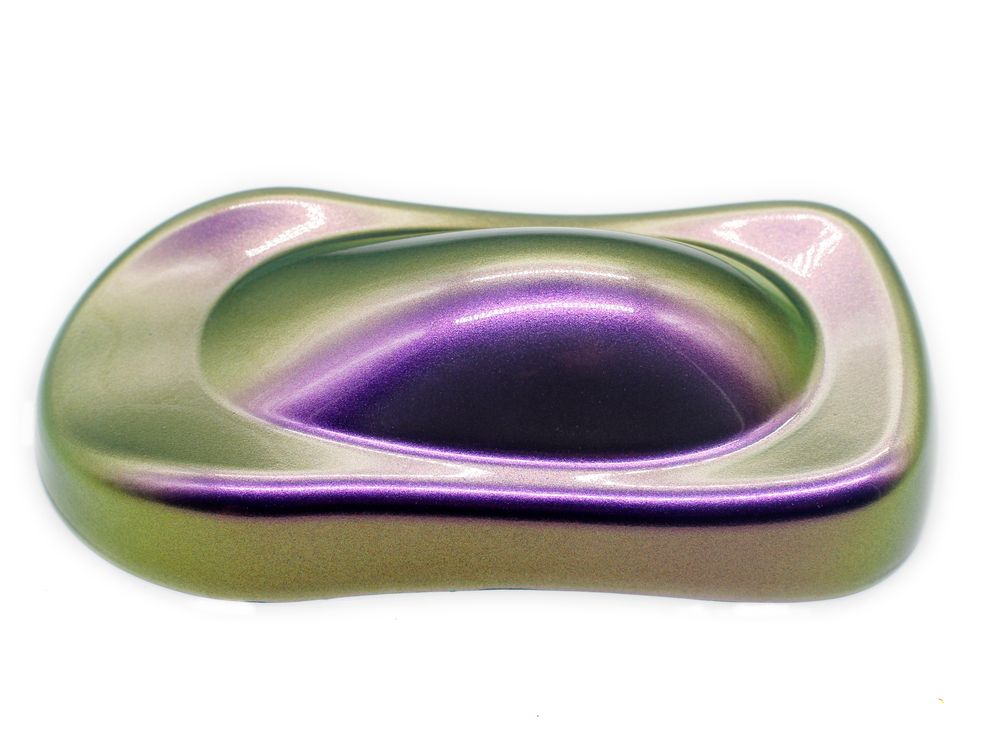
Chameleon effect pigment demonstrating multi-angle color travel for specialty automotive finishes.
In this guide, we compare the main types of pearlescent pigments for automotive applications, explain how to select the right particle size and visual effect, and introduce Kolortek's pigment solutions for automotive paint manufacturers and coating formulators.
What Are Pearlescent Pigments in Automotive Paint?
Pearlescent pigments are special effect colorants that create a pearl-like appearance through the reflection, transmission, and interference of light. Most conventional pearlescent pigments are manufactured using thin mica or synthetic mica flakes coated with titanium dioxide, iron oxide, or other metal oxides.
When incorporated into an automotive coating, these plate-like particles can align within the paint film. Their optical structure produces a distinctive luster that changes with lighting conditions and viewing angles.
Unlike conventional solid-color pigments, pearlescent pigments contribute both color and visual depth. Depending on the pigment grade, the finished automotive paint may display:
- Soft pearl white and silver reflections.
- Metallic brilliance with a warm golden or bronze appearance.
- Color interference effects, such as blue, violet, green, and red highlights.
- Multi-angle color travel and chameleon effects.
- Bright, crystal-like sparkle for premium automotive finishes.
For automotive paint manufacturers, the main advantage is the ability to create differentiated finishes without relying entirely on conventional colorants. The appropriate pigment selection also helps maintain the desired appearance across different production batches.
Best Types of Pearlescent Pigments for Automotive Paint and Coatings
Not all pearlescent pigments produce the same visual result. Some are designed for smooth, elegant pearl finishes, while others focus on stronger reflections, color saturation, or dramatic color changes.
The following pigment types are particularly relevant to automotive OEM coatings, automotive refinish paints, motorcycle coatings, and customized vehicle finishes.
Silver White Pearlescent Pigments for Classic Automotive Finishes
Silver white pearlescent pigments are a popular choice for automotive coatings that require a clean, refined, and elegant appearance. They produce a soft pearl reflection with different brightness levels depending on the particle size and coating structure.
Kolortek's KT-100 Silver White Series is based on natural mica coated with rutile titanium dioxide. It provides a balanced silver pearl effect and is available in multiple particle size grades for different coating requirements.
For automotive paint manufacturers developing pearl white, silver white, or subtle metallic-like finishes, KT-100 offers a practical starting point. The finer grades are suitable for smoother visual effects, while medium particle sizes provide stronger pearl reflections.
Recommended product: KT-100 Silver Pearl Mica Pearlescent Pigment.

Silver white pearlescent mica pigment for bright pearl and satin coating effects.
Interference Pearlescent Pigments for Color-Rich Automotive Paint
Interference pigments are suitable for automotive coatings that need more than a standard silver pearl appearance. By controlling the thickness of the titanium dioxide coating, manufacturers can produce different interference colors, including gold, red, violet, blue, and green.
These pigments create an attractive combination of reflected pearl light and color highlights. Their appearance depends on the pigment structure, basecoat color, film thickness, and viewing angle.
Kolortek's KT-200 Interference Series is available in multiple color options for formulators developing tinted pearl coatings and specialty automotive finishes. Synthetic mica alternatives are also available through the KT-7200 series.
For a more saturated interference effect, formulators should evaluate the pigment against different basecoat colors rather than relying on powder appearance alone. Darker substrates can enhance certain interference colors, while lighter backgrounds may produce a softer pearl effect.
Explore the Kolortek Interference Pearlescent Pigments for additional color and grade options.
Metal Luster Pearlescent Pigments for Gold and Bronze Automotive Effects
Some automotive paint designs require a warmer metallic appearance rather than the cooler reflection of standard silver pearl pigments.
Metal luster pearlescent pigments use iron oxide-coated mica flakes to create rich gold, bronze, copper, and reddish metallic tones. The thickness of the iron oxide coating influences the final color and visual intensity.
Kolortek's KT-500 natural mica and KT-7500 synthetic mica series provide different substrate options for manufacturers looking to develop warm metallic coating effects.
These pigments are worth considering for customized automotive finishes, specialty vehicle coatings, and decorative automotive components where a distinctive warm metallic appearance is required.

Metal luster pigment with a warm bronze-gold metallic appearance.
For more product specifications and particle size options, see Kolortek Metal Luster Pearlescent Pigments.
Synthetic Mica Pearlescent Pigments for Premium Automotive Coatings
When color purity, brightness, and batch consistency are important, synthetic mica-based pearlescent pigments deserve consideration.
Synthetic mica, also known as fluorphlogopite, offers a more controlled substrate structure than conventional natural mica. It can provide a cleaner background, fewer mineral inclusions, and improved visual uniformity in suitable pigment grades.
Kolortek offers synthetic mica options across several product families, including Silver White, Interference, Gold, and Metal Luster series.
For premium automotive coatings, synthetic mica grades can be evaluated when formulators require brighter pearl effects, cleaner color presentation, or tighter appearance control. The final choice should still be confirmed through coating trials and batch comparison.
Borosilicate Pearlescent Pigments for Diamond-Like Automotive Sparkle
For automotive finishes that require stronger sparkle and exceptional visual brightness, borosilicate glass-based effect pigments provide another option.
Kolortek's KT-8000 DreamStar Series uses calcium aluminum borosilicate flakes coated with titanium dioxide and other metal oxides. Its transparent substrate and smooth platelet structure create a bright, crystal-like sparkle.
These pigments are particularly interesting for high-end automotive styling, specialty coatings, and customized finishes where a more pronounced sparkle is part of the design objective.
Compared with standard mica-based pearl pigments, borosilicate grades can produce a different visual character, especially when light passes through the transparent flakes and reflects from their coated surfaces.
View the KT-8000 DreamStar Borosilicate Glass Pigments for more details.
Chameleon and Color-Shift Pigments for Custom Automotive Paint
For automotive brands and custom paint manufacturers looking to create a more distinctive appearance, chameleon and color-shift pigments offer a different level of visual impact.
Unlike standard silver white or interference pearl pigments, these effect pigments are designed to display noticeable color transitions as the viewing angle changes. A single painted surface may appear blue-green from one direction and violet or red from another.
This effect is produced through controlled optical interference within layered pigment structures. It is particularly attractive for luxury vehicle finishes, motorcycle coatings, customized car paint, and specialty automotive refinish applications.
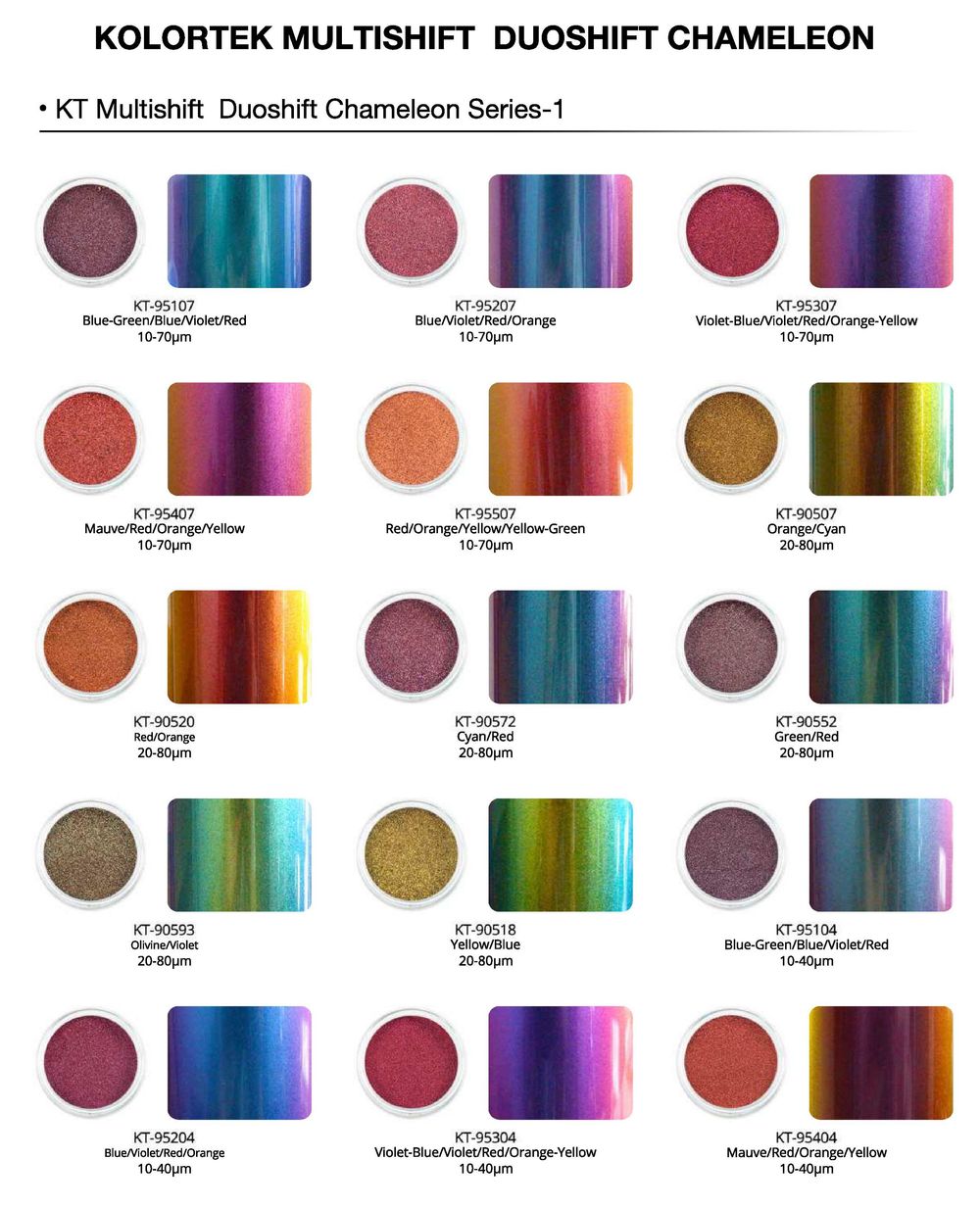
Kolortek multishift and duoshift chameleon pigment color options.
KT-9000 Magic Chameleon Series
Kolortek's KT-9000 Magic Chameleon Series is developed for applications that require multi-angle color travel. Based on layered mineral substrates coated with metal oxides, these pigments produce different color appearances depending on the viewing angle.
Available particle sizes range from fine grades below 15 μm to larger 100–250 μm grades, allowing formulators to adjust the balance between smooth color transitions and visible sparkle.
Standard grades are suitable for automotive coating development where controlled color travel is required. Larger flakes can create a bolder appearance for custom vehicle finishes and show-car applications.
See Kolortek KT-9000 Chameleon Pigments for available colors, technical information, and application options.
Chromashift Pigments for High-Contrast Color Travel
For coating manufacturers who want a stronger and more dramatic color-shifting effect, Chromashift pigments are another option to consider.
These optically variable pigments use a multilayer inorganic structure to create distinct color transitions. Depending on the selected grade, the coating can display combinations such as blue-red, green-orange, red-yellow, or other multi-color effects.
Kolortek's Chromashift range is designed for specialty automotive paint applications and can be evaluated in different coating systems. Fine particle grades are generally more suitable when a smoother surface appearance is required, while larger grades provide stronger sparkle and visual contrast.
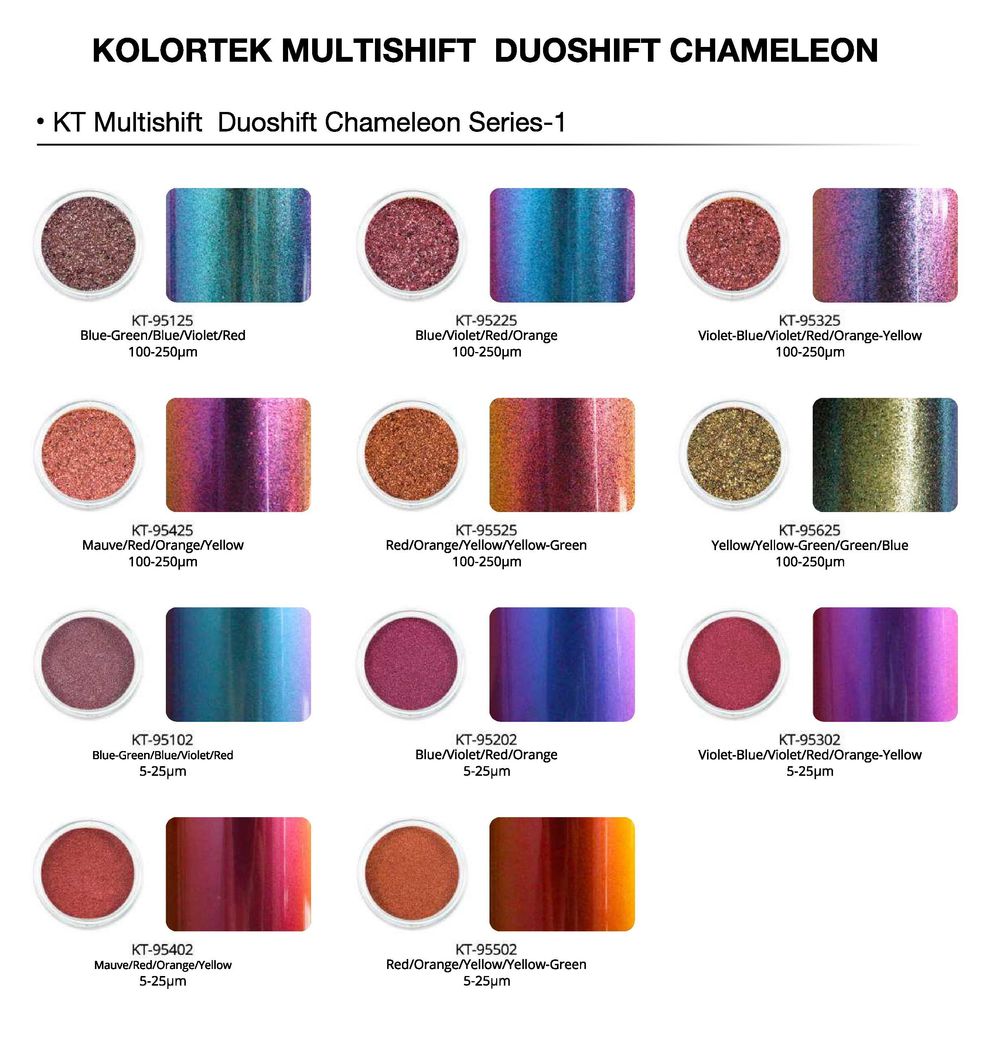
Different particle sizes and color combinations for multi-angle automotive paint effects.
For automotive paint formulators interested in high-contrast optical effects, Kolortek Chromashift Color Travel Pigments for Auto Paint offer a dedicated product direction.
How to Choose the Right Pearlescent Pigment for Automotive Coatings
Selecting the best pearlescent pigment requires more than comparing colors. Automotive coatings have specific requirements for appearance, spray performance, film formation, weathering resistance, and production consistency.
Before choosing a pigment, automotive coating manufacturers should evaluate the following factors.
Particle Size and Surface Appearance
Particle size is one of the most important factors affecting the final visual result.
- Fine particles below 15 μm: Suitable for smooth, subtle pearl effects and applications where surface uniformity is important.
- Medium particles around 10–60 μm: Provide a balance between pearl brightness, sparkle, and surface appearance. They are a useful starting point for many spray coating trials.
- Larger particles around 60–100 μm: Create stronger visible sparkle and more noticeable reflective effects, subject to spray equipment and film requirements.
- Coarse particles above 100 μm: Better suited to selected specialty and custom finishes where pronounced flakes are desired. Sprayability and surface smoothness require careful evaluation.
For standard automotive production, finer and medium particle sizes are generally the more practical starting points. Larger particles should be selected according to the application method, coating thickness, and desired appearance.
Basecoat Color and Pigment Compatibility
The basecoat color has a direct influence on the appearance of pearlescent and interference pigments.
Silver white pigments can produce a clean pearl effect over light-colored substrates, while some interference and chameleon pigments show stronger color contrast over dark backgrounds.
For example, black or dark-colored basecoats generally help enhance the color travel of chameleon and Chromashift pigments. A light background may reduce the visible contrast because more background light is reflected through the coating.
Compatibility with the binder, resin system, dispersants, and other additives must also be confirmed. A pigment that performs well in one formulation may require adjustments when transferred to another coating system.
Weather Resistance and Thermal Stability
Automotive exterior coatings are exposed to sunlight, temperature changes, moisture, road contaminants, and repeated cleaning. Therefore, pigment selection should consider more than the initial color appearance.
Important evaluation points include:
- UV and outdoor weathering performance.
- Thermal stability under the intended automotive baking conditions.
- Chemical compatibility with the selected resin and coating additives.
- Color stability after accelerated aging tests.
- Resistance to changes in appearance during storage and application.
- Batch-to-batch color consistency.
Always request grade-specific technical data and conduct weathering and compatibility tests using the actual automotive coating formulation. Performance requirements should be verified for each selected grade rather than assumed to be identical across an entire pigment series.
Dispersion and Application Performance
Pearlescent pigments have a platelet-like structure that contributes to their optical performance. Excessive mechanical shear can damage these particles or affect their orientation in the coating film.
For this reason, formulators should use an appropriate low-shear dispersion process and avoid unnecessary high-energy grinding after pigment addition. The mixing procedure should be optimized according to the pigment grade and binder system.
Spray trials are also important. Film thickness, flash-off conditions, spray pressure, and application technique can all influence particle orientation and the final visual effect.
Automotive Pearlescent Pigment Comparison Guide
The following comparison summarizes the main Kolortek pigment options and their potential automotive coating applications. It can help coating formulators narrow down the most suitable product family before requesting samples.
| Pigment Series | Visual Effect | Suitable Applications | Main Selection Focus |
|---|---|---|---|
| KT-100 Silver White | Classic silver pearl | Pearl white and silver automotive finishes | Smoothness and pearl brightness |
| KT-200 Interference | Colored interference reflections | Tinted pearl and specialty coatings | Color and substrate selection |
| KT-500 Metal Luster | Gold, bronze, and warm metallic luster | Custom automotive and decorative finishes | Metallic tone and opacity |
| KT-7000 Synstar | Bright synthetic mica pearl | Premium pearl coating development | Purity and visual consistency |
| KT-8000 DreamStar | Crystal-like sparkle | Premium specialty automotive finishes | Transparency and sparkle |
| KT-9000 Chameleon | Multi-angle color travel | Custom car paint and motorcycle coatings | Color shift and particle size |
| Chromashift | High-contrast optical color shift | Specialty and luxury automotive finishes | Color travel and weathering data |
There is no single best pearlescent pigment for every automotive coating. The right choice depends on whether the project prioritizes a smooth pearl appearance, stronger metallic reflections, high sparkle, or dramatic color travel.
Why Automotive Paint Manufacturers Choose Kolortek
Finding a suitable pigment is only one part of automotive coating development. Manufacturers also need a supplier that can provide stable product quality, consistent color performance, technical documentation, and reliable support throughout the formulation process.
Kolortek focuses on pearlescent pigments and special effect pigments for industrial and decorative applications, with product options designed for automotive coatings and other specialty coating markets.
Broad Automotive Effect Pigment Selection
From silver white and interference pearl to metallic luster, synthetic mica, borosilicate, chameleon, and Chromashift pigments, Kolortek provides multiple effect technologies for different automotive coating projects.
Manufacturing Experience and Quality Control
With more than 20 years of manufacturing experience, Kolortek focuses on particle size control, coating consistency, and batch stability. Its ISO 9001:2015 quality management system supports standardized production and quality control procedures.
Custom Color and Particle Size Solutions
Different automotive projects often require specific color combinations, particle size distributions, or substrate characteristics. Kolortek supports customized pigment development and OEM/ODM services for customers with defined product specifications.
Technical Documentation and Application Support
Technical data sheets, safety documentation, and other available product documents help coating manufacturers evaluate pigment suitability. The technical team can also assist with sample selection, color matching, and formulation-related questions.
Global B2B Supply Capability
Kolortek works with customers in international markets, supplying effect pigments for manufacturers, distributors, and industrial coating businesses. Sample evaluation and product discussions can help buyers identify suitable grades before moving to larger-volume orders.
For a broader overview of the company's coating solutions, visit Kolortek Pigments for Paints & Coatings.
How to Get Started with the Right Automotive Pearlescent Pigment
If you are developing a new automotive paint formulation or looking for an alternative effect pigment supplier, it is helpful to prepare a few technical details before requesting a quotation or samples.
- Target appearance: Pearl white, silver, interference color, metallic gold, crystal sparkle, or chameleon color travel.
- Coating system: Water-based, solvent-based, or UV-curable formulation.
- Application method: Spray coating, automotive refinish, or another coating process.
- Particle size preference: Fine, medium, or coarse effect particles.
- Performance requirements: UV resistance, thermal stability, chemical compatibility, and color consistency.
- Order requirements: Sample quantity, estimated annual demand, and customized specifications.
Providing these details allows the supplier to recommend more relevant pigment grades instead of offering a general product list that may not match your formulation.
Whether you are sourcing standard pearl pigments for production or developing a distinctive color-shifting automotive finish, Kolortek can help you evaluate suitable effect pigment options for your application.
Contact the Kolortek team to discuss your automotive coating requirements, request product samples, or obtain technical information for your next formulation project.
Frequently Asked Questions About Pearlescent Pigments for Automotive Paint
What are the best pearlescent pigments for automotive paint?
The best choice depends on the desired finish. KT-100 Silver White is suitable for classic pearl effects, KT-200 Interference produces colored reflections, KT-500 Metal Luster creates warm metallic tones, and KT-9000 Chameleon or Chromashift is suitable for multi-angle color-shifting finishes. Kolortek offers these product families for automotive coating development.
What particle size is best for automotive pearlescent pigments?
Particle sizes around 10–60 μm are a practical starting point for many spray-applied automotive coatings because they balance visual effect and surface appearance. Fine particles below 15 μm can produce smoother finishes, while larger particles create stronger sparkle but require additional evaluation for sprayability and film smoothness.
Can pearlescent pigments be used in automotive clearcoat?
Some effect pigments can be incorporated into suitable clearcoat formulations, but the compatibility, transparency, dispersion process, and application requirements must be confirmed for each grade. Many automotive effect systems use a pigmented basecoat followed by a transparent protective clearcoat.
What is the difference between pearlescent and metallic pigments in car paint?
Conventional metallic pigments, such as aluminum flakes, create a reflective metallic appearance. Pearlescent pigments typically use coated mica or other transparent platelet substrates to produce pearl luster and interference colors. Metal luster pearlescent pigments combine warm metallic-looking tones with a mica-based effect pigment structure.
Why are chameleon pigments used in automotive coatings?
Chameleon pigments create visible color changes as the viewing angle changes. They are used in custom car paint, motorcycle coatings, and premium specialty finishes where a distinctive multi-color appearance is desired. A dark basecoat generally helps maximize the color-shifting effect.
Are Kolortek pearlescent pigments suitable for water-based and solvent-based automotive paints?
Kolortek offers effect pigment grades for different coating systems, including water-based and solvent-based applications. However, compatibility depends on the individual pigment grade, binder chemistry, additives, and formulation conditions. Buyers should confirm the recommended grade and conduct application testing before production.
Does Kolortek provide customized automotive pearlescent pigments?
Yes. Kolortek supports customized color development, particle size selection, and OEM/ODM services. Automotive paint manufacturers can discuss their target color, coating system, application method, and technical requirements with the Kolortek team.
How can I request automotive pearlescent pigment samples from Kolortek?
Contact Kolortek with your desired effect, color, particle size, coating system, and estimated quantity. The team can help identify suitable product grades and discuss sample availability, technical documents, and quotation requirements.